
Black Infant Mortality Crisis at Center of New Coalition’s First Event
Black babies in Vanderburgh County are dying at a rate 3 times the state and national average.
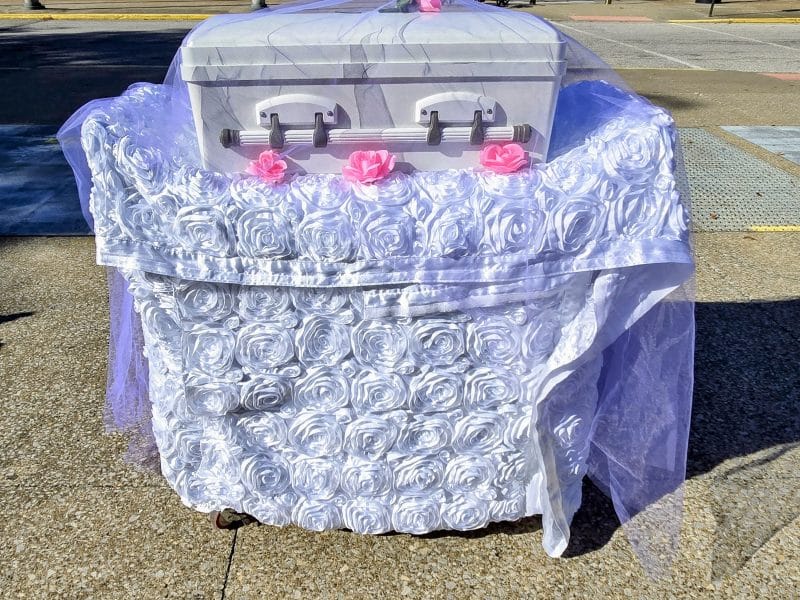
Under the rays of the cheerful sunshine, on Saturday morning, a tiny white casket with pink roses rested in front of the Civic Center in Evansville. Residents dressed in black, gathered around it, some pushing empty strollers, others holding signs that read “Our babies are dying.” Reminiscent of losing a loved one, the atmosphere was heavy. That feeling was intentional, meant to evoke empathy, understanding, and confront the stark reality of infant mortality.
In 2022, more than 500 infants in Indiana died before reaching their first birthday. The state’s infant mortality rate sits at 7.2 deaths per 1,000 live births, far above the national rate of 5.6. The disparities are even sharper among Black families: between 2020 and 2022, Black infants in Indiana died at a rate of 12.2 per 1,000 live births, more than double the rate of white infants (5.9). For Vanderburgh County, the numbers are even worse. Black babies are dying at a rate more than three times the national average — 18 deaths per 1,000 live births between 2019 and 2023.
Indiana’s infant mortality crisis is what brought local advocates together this weekend to launch the Dream Savers Alliance. With the theme “Taking Back Our Future: Turning Our Pain into Purpose,” the event kicked off with the buggy parade, where participants pushed empty strollers and wagons to honor infants that passed before their first birthday. The march ended at the CK Newsome, with a moment of silence and ringing the bell 19 times — one for each infant lost in Indiana in August.
The Formation of Dream Savers Alliance
The coalition, led by community advocates LaRissa Madison, Cherri Johnson, Joann Hunter, Dr. Thomas Stratton, and LaKeisha Roach, was established to confront the alarming rates of infant mortality and maternal health challenges, especially within the African American community. The coalition focuses its efforts on raising awareness, fostering understanding, and driving meaningful change for those most affected. “We started before we became Dream Savers,” said Johnson. “We were just people, sitting in kitchens, handwriting signs, borrowing what we needed, and making it happen.” But as the small group began to share what they were doing with others, several joined the movement.
From those conversations came a focus on the real barriers families face. The coalition pointed to a variety: limited access to prenatal and postpartum care, systemic racism in healthcare, and the toll of chronic stress. “Stress takes a toll on the body—probably more than anything else. And that’s the stress of just living while Black,” said Joann Hunter. Johnson added that while medical care is important, people need to be heard.
Community Education and Voices
Inside the CK Newsome Center, community members attended presentations on infant and maternal mortality, preeclampsia risks, breastfeeding, and safe sleep practices. The program also included an infant CPR demonstration, survey, and a panel discussion featuring Gerry Brower, Kersecilia Patterson, and Tamiko Garth. Many residents said they felt unheard in medical spaces or didn’t know where to find support. Others shared stories of stress and isolation, which emphasizes the need for trusted community advocates. Hunter urges starting close to home: “My circle starts at home. Build community within your own walls and work outward.” Organizers said the coalition will keep meeting families where they are — in homes, churches, and community spaces — to build trust and continue the conversation. “You don’t have to be a nurse or professional to be part of this. You just have to care. That’s the prerequisite,” Johnson said.
How the Alliance Measures Success
For the coalition, success looks like more than just lowering statistics. It’s about empowering families to take steps to protect mothers and infants in everyday life. Community members are encouraged to help one another, support healthier choices during pregnancy, and teach expecting mothers how to advocate for themselves. That includes learning to track their own health by taking notes, communicating clearly with providers, and — instead of going home discouraged if they feel unheard — being persistent until they get answers.
At Saturday’s event, every guest received an “advocacy kit” with a notepad and pen tucked in a small pouch, a simple but powerful tool for writing down questions and important information to bring to appointments. Organizers also stressed the importance of challenging old traditions and habits that may put infants at risk. Safe sleep, in particular, was highlighted as a critical area where communities must “do things differently because we know better.” “Information hits different when it comes from someone who carries the same cultural memory,” said Madison (as read by Johnson). “Seeing is believing. And once you know, you can’t unknow.”
A Call for Better Maternal Healthcare
Organizers emphasized that Saturday’s event was not only about mourning but about building momentum for change — a collective call for better maternal healthcare, more community support, and stronger accountability from local systems. While no major policy announcements came during the event, local leaders pledged to continue dialogue and coordinate future gatherings. Coalition members said they hope city and state officials will formally recognize Infant Mortality Awareness Month in September and commit to elevating the voices of affected families.
The Dream Savers Alliance began as neighbors in kitchens and libraries, motivated by personal stories of loss, growing health disparities, and the recognition that this is something communities must tackle together. What began as an urgent need for honest conversations has grown into action. Today, members see themselves as proof that change can start anywhere. “The power is in the people’s hands,” Johnson said. “Their voices need to be heard.”
Author
Related Articles

Rotary Club honors Sondra Matthews with Civic Award
Sondra Matthews has spent decades telling Evansville’s stories, preserving Black history, mentoring leaders, and building institutions that continue to shape the community. Now, the Rotary Club of Evansville has honored her with its 2026 Civic Award—recognizing a legacy rooted in faith, service, and generations of impact.

More Than Remembrance: Evansville Honors the Life and Legacy of Dr. King
The community honored the life and legacy of Dr. King through various celebrations across the city of Evansville.
Indiana Senate Rejects Redistricting Plan After Intense Debate
Indiana Senate rejects redistricting plan.