
Beyond Black Panther: The Rise of Sword and Soul
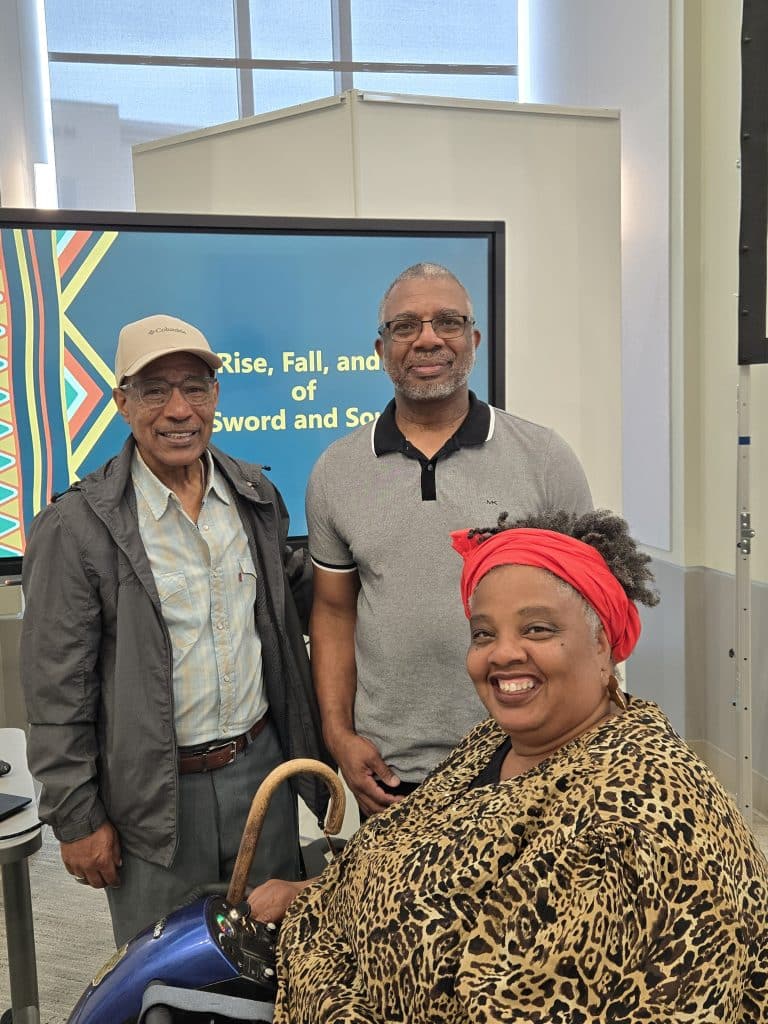
Award-winning author Milton J. Davis visited Evansville’s BIPOC Comic Fest to explore the origins of Sword and Soul, a fantasy genre rooted in African history, mythology, and culture. His presentation traced the movement from Charles R. Saunders to today’s independent creators, showing how Black authors are reshaping fantasy by telling their own stories.
Beyond Black Panther
At the clifftop, beneath an open sky filled with sunlight and the calls of birds, the clans gather in anticipation of a new king. Standing in the river below, their chests painted and their spears and shields ready, warriors await the signal. The drumroll begins. Spears rise. The battle for the throne is underway.
When Prince T’Challa emerges victorious and is crowned king of Wakanda—the technologically advanced African nation hidden from the outside world—he becomes the Black Panther.
Inspired by African history, culture, and mythology, Black Panther captured the imagination of audiences around the world. Through comic books and later the big screen, it celebrated themes of identity, heritage, innovation, and possibility.
Yet for award-winning author and publisher Milton J. Davis Jr., one of the leading voices in the Sword and Soul literary movement, Black Panther represents both progress and a missed opportunity.
“I’m lukewarm about Black Panther because it’s kind of odd to me that one of the most popular Black characters in the comic book universe wasn’t created by somebody Black,” Davis said. However, he balanced his perspective by praising director Ryan Coogler’s adaptation and the cultural impact the film had on Black audiences, particularly young people.
But his comments pointed to a broader conversation at last Saturday’s BIPOC (Black, Indigenous, and People of Color) Comic Fest, which was hosted by Evansville Vanderburgh Public Library (EVPL) in partnership with the Evansville African American Museum Soul Writer’s Guild. For decades, African history, mythology, and Black heroes were often absent from fantasy literature or portrayed through stereotypes.
The Birth of Sword and Soul
That absence helped inspire the creation of Sword and Soul, a fantasy subgenre that blends the sword-and-sorcery tradition with African mythology, history, and culture. The result is action-driven fantasy rooted in pre-colonial African worlds.
The genre emerged in the late 1970s by the late Charles R. Saunders, whom Davis calls “the founder of Sword and Soul,” and would later become a mentor and collaborator. Saunders created Imaro, widely recognized as the first Black sword-and-sorcery hero, after becoming frustrated with how Africa and African people were portrayed in popular adventure stories.
Among those influences was Tarzan. Davis said Saunders enjoyed the stories but was troubled by their portrayal of Africans as primitive, fearful, or dependent on white explorers. “If you’ve ever read Tarzan…you know it’s not done very well,” said Davis. Saunders also admired Robert E. Howard’s Conan stories but recognized that Black characters were often depicted through stereotypes or pushed to the margins.
Reclaiming African History
Instead of accepting those narratives, Saunders imagined a different story: one where African heroes navigated worlds inspired by African history and culture. Davis said Saunders’ work was also influenced by historians such as Cheikh Anta Diop and Basil Davidson, whose research challenged long-held misconceptions by documenting Africa’s advanced civilizations from perspectives often omitted from Western history books.
Those works demonstrated that Africa’s history extended far beyond the stereotypes many readers had inherited. “There was a real big push of trying to explain why slavery wasn’t that bad and why what Europeans were doing to Africans was actually in their benefit,” Davis said. “They were painting this picture that Africa was this vast, underdeveloped area.”
In Sword and Soul, African kingdoms, cultures, and heroes are not supporting characters, but the foundation of the story itself.
Following Saunders’ Path
Years later, Davis found himself asking many of the same questions as Saunders. A former research chemist, Davis said he began studying African history in the 1990s after realizing he knew more about European history than the history of his own ancestors.
“I started doing honest research and I got really excited about it,” Davis said. ‘I needed to express this in some kind of way.'”
That research inspired his first Sword and Soul novel, Meji, which drew from multiple African cultures and traditions. “I wanted to show as many different African cultures as I could because people always view Africa as a country, but we know Africa is a continent that consists of thousands of different cultures,” Davis said.
His work eventually led him to Saunders. After discovering Imaro through a reissue by Night Shade Books, Davis reached out to the author and asked if he would read the manuscript for Meji. Saunders agreed, marking the beginning of a friendship and professional relationship that would help shape the future of the genre. “That’s basically how our relationship started,” Davis said.
For Davis, writing the stories fulfilled a personal passion, but sharing his work with the world would prove to be challenging. Traditional publishers did not embrace the stories he wanted to tell. “I researched the market and realized that publishers really wouldn’t be interested in what I was doing, or they really wouldn’t let me do it the way that I wanted to do it,” he said.

Joining the Publishing Movement
Inspired in part by the growing success of independent authors, Davis decided to self-publish, and in 2005 founded MVmedia. “I said, ‘If they can do that, I can do that too. So, I started studying the process and got started.”
As his publishing company grew, Davis helped publish other writers exploring African-centered fantasy and worked alongside Saunders to expand the Sword and Soul genre through anthologies such as Griots and Sisters of the Spear. Those collections provided opportunities for writers whose stories often struggled to find a place in traditional publishing.
Davis believes independent publishing has helped challenge long-held assumptions about Black authors and readers. “The stereotypes that people believed about Black authors and about audiences in general—what they will accept and what they won’t accept—is not necessarily what the powers that be think,” Davis said.
Independent publishing reshapes who gets to tell fantasy stories. What began as a small community of writers has now grown to include authors and artists across Africa, the African diaspora and the Caribbean. He also noted that African writers are drawing directly from their own cultural traditions. Unlike African American writers, whose work often reflects the blended experiences of the African diaspora.
Writers living in Africa frequently build stories around specific cultures such as the Igbo, Yoruba, Swahili, or Xhosa, bringing readers deeper into the diversity of the continent’s histories and mythologies. It is the kind of growth Saunders envisioned when he first created Sword and Soul, and one Davis has continued to nurture through his own writing and publishing.
Inspiring the Next Generation
Comic books and graphic novels have become more than entertainment. For many readers, they serve as an entry point into literature, creativity, and cultural exploration.
At the conclusion of his presentation at the BIPOC Comic Fest, Davis was asked how adults can encourage creativity and a love of reading in young people. He encouraged families and educators to pay attention to the interests young people already have and to help them build on those interests through libraries, writing programs, and art workshops. Whether the starting point is a novel, a comic book, or an animated series, Davis believes every story has the potential to inspire another.
For Davis, that is how genres like Sword and Soul continue to grow—not only through the stories being told today, but through the next generation of storytellers.
“Readers are writers,” Davis said.
Author

Related Articles

On The Shelf: Ice Cream Queen: Flavor from Black America’s Past, Present, and Future
Cool off with a scoop of history, culture, and irresistible flavor in this week’s On The Shelf review. Ice Cream Queen by Lokelani Alabanza blends Black culinary history with joyful recipes and sweet summer inspiration—perfect for readers who love food, heritage, and a little something delicious on the page.

Freedom Remembered, Community Celebrated: Juneteenth Across the Tri-State
Across the Tri-State, Juneteenth brought neighbors together in a shared celebration of freedom, history, and community—reminding us that unity is one of freedom’s greatest legacies.