Native American Tributes mark the birthdays of Muhammad Ali and Martin Luther King Jr.
BY RODNEY RICHARDSON | THE WAY OF THINGS
Two great African American leaders whose birthdays are honored every year by Native Americans are Dr. Martin Luther King Jr., born on January 15, 1929, and Muhammad Ali, born on January 17, 1942. Both men (Capricorns) are held in the highest esteem and commemorated for their heroic actions that helped free Native Americans from oppressive situations here in the U.S. and abroad. The deeds they accomplished on behalf of certain tribal nations (benefiting all) are not documented in common American History books–however, they are not forgotten in the hearts and minds of Native Americans.
Indian Country remembers Dr. King not only as a passionate Trailblazer for civil rights but also as a powerful champion for Native issues–inspiring the ongoing pursuit of maintaining social equality. Although he had The Dream of uniting people of all colors– in the words of Native American Journalist, Tristan Picotte: Dr. King– “specifically advocated for the desegregation of Native Americans and inspired much of the modern-day advocacy for Native rights, including water rights and tribal sovereignty. Many advocacy groups for tribes, such as the Native American Rights Fund, arose shortly after the era of Dr. King in the wake of the Civil Rights Movement.”
Native Americans reflect on and embrace the following excerpt from King’s 1963 book entitled–Why We Can’t Wait: Our nation was born in genocide when it embraced the doctrine that the original American, the Indian, was an inferior race. Even before there were large numbers of Negroes on our shores, the scar of racial hatred had already disfigured colonial society. From the sixteenth century forward, blood flowed in battles of racial supremacy. We are perhaps the only nation that tried as a matter of national policy to wipe out its Indigenous population. Moreover, we elevated that tragic experience into a noble crusade. Indeed, even today we have not permitted ourselves to reject or feel remorse for this shameful episode. Our literature, our films, our drama, our folklore all exalt it.”
brought Dr. King to the aid of tribal leaders of the Poarch Band of Creek Indians working to desegregate their schools in South Alabama during the late 1950s. At the time, lighter-skinned Native children were allowed to ride school buses to previously all-white schools, but dark-skinned Native kids from that same tribe were not. With King’s assistance, the problem was quickly resolved and all Native kids from the same band rode together marking a major step toward desegregation.
Now why do Native Americans memorialize Muhammad Ali (aka “The Greatest”)? As everyone knows (or should know) Ali was not only a three-time world heavyweight boxing champion but also a major icon in the Civil Rights Movement of the 1960s. One of his most expressive, impressive, and profound quotes (defending his resistance to the draft)–“Why should they ask me to put on a uniform and go 10,000 miles from home and drop bombs and bullets on Brown people in Vietnam while so-called Negro people in Louisville are treated like dogs and denied simple human rights? No, I’m not going 10,000 miles from home to help murder and burn another poor nation simply to continue the domination of white slave masters of the darker people the world over.”
Ali was a champion fighter against the injustices of American Indians as he was a champion in the boxing ring.
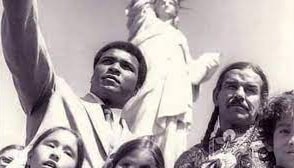
In 1978, 300 American Indians trekked across America from California to Washington DC–known as “The Longest Walk.” It took five months to get there. The purpose was both a political and spiritual demonstration. The Indians were challenging the policies enacted by Congress at the time that violated treaty rights, particularly concerning Indian land, fishing, and mineral rights while educating people about Indigenous culture. Ali along with other celebrities was a strong supporter of the Movement–actively participating in many of the protests. He helped fight “the Good Fight.”
Related Articles
Carver at 80: Where Evansville’s Kids Became Leaders
At Bally’s, former “Carver kids” reflect on how one community center shaped their lives and the city.