
Hearing Delayed Again as High Spirits Faces Environmental Violations
The permit decision for the High Spirits case continues.
By Paola Marizan
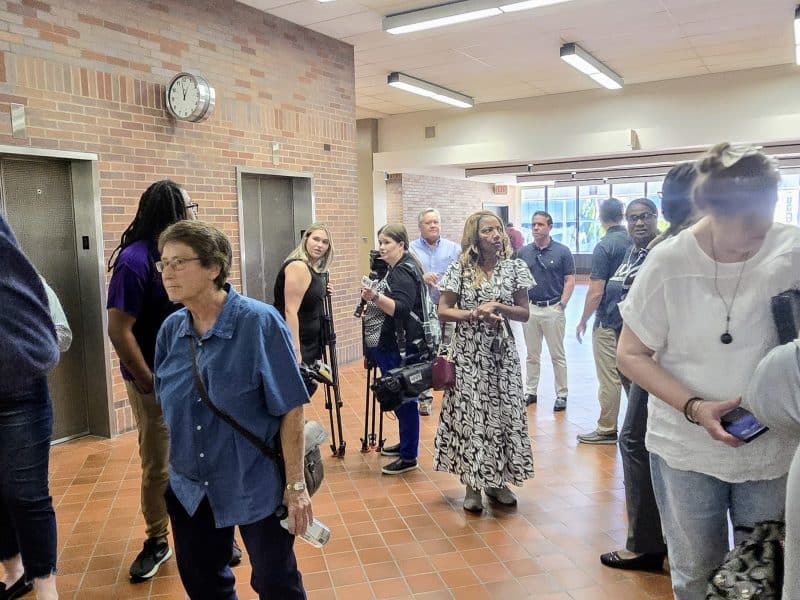
The long-running fight over the High Spirits liquor store permit at 325 S. Kentucky Avenue is being pushed back yet again. During Tuesday’s meeting, store owner Pawandeep Sooch requested a continuance, which the Vanderburgh County Alcohol Beverage Board granted, rescheduling the hearing for Tuesday, November 25, at 1 p.m.
The delay adds to growing frustration among residents who have spent months organizing around the issue. The last hearing was postponed due to a lack of quorum, and many attendees say they’re tired of seeing the process stall.
“They are trying to wear us down by dragging this on, but we will keep showing up,” said Stephanie Gibson after the announcement.
The ongoing permit dispute has become about more than just one business. For many on Evansville’s South Side, it’s now a question of accountability, how decisions about development are made, and whether community voices truly matter.
Community Voices at the Center
The controversy began when residents discovered that the liquor store had opened without proper public notice, a procedural failure that state officials later confirmed violated Indiana’s permit requirements. The case was sent back to the local board for review, giving residents another chance to be heard.
Community advocate Shona Jarboe, who has followed the case since its beginning, said a recent Indiana Department of Environmental Management (IDEM) inspection of the property has deepened concerns about oversight and accountability. The inspection found 17 violations related to the site’s underground gasoline storage tanks, violations that Jarboe says could pose long-term environmental and safety risks if not corrected.
“These findings make it clear this isn’t just about paperwork or zoning,” she said. “It’s about public health, safety, and the city’s responsibility to make sure businesses follow the law.”
Business Response and What Comes Next
Store owner Pawandeep Sooch and his attorney Scott Bedwell said they respected the board’s decision and were evaluating their next steps. If Sooch appeals, the case could return to the Indiana Alcohol and Tobacco Commission (ATC) for review.
Meanwhile, IDEM officials will monitor whether the environmental violations are resolved according to state regulations. The outcome of that process could influence whether the liquor store ultimately continues to operate at its current location.
For residents, that uncertainty is about more than one business, it represents a crossroads for their neighborhood. If the violations are corrected and the permit is approved, neighbors say they’ll be watching closely to ensure safety and accountability. If not, many hope the decision opens the door for new possibilities, such as small businesses or community spaces that better reflect the needs of the area.
As Evansville continues to wrestle with questions of development, equity, and neighborhood voice, the High Spirits case remains a test of how responsive local systems can be to the people they serve.
The Our Times Newspaper will continue following updates on the liquor store permit, the IDEM findings, and ongoing efforts to strengthen accountability and communication between residents, businesses, and local officials.
SIDEBAR: What IDEM Found at the High Spirits Property
According to IDEM records, the following findings were identified:
- Old fuel tanks not properly tested or monitored. The underground storage tanks hadn’t undergone the required leak detection tests for months.
- No corrosion protection system in place. The metal tanks lacked the protection needed to prevent rusting and leaks.
- Spill prevention equipment missing or broken. IDEM inspectors found that catchment basins and spill buckets were either damaged or not being used.
- Improper fuel line maintenance. Lines carrying gasoline to pumps hadn’t been pressure-tested or inspected for leaks as required by law.
- Missing or incomplete inspection records. The business couldn’t provide logs showing that safety checks or repairs had been performed.
- Failure to properly label fuel lines and tank areas. Signs and labeling required for emergency response were absent or illegible.
- No evidence of trained personnel. IDEM found no proof that staff had completed the mandatory underground storage tank safety training.
- Unreported maintenance issues. Problems discovered earlier in the year had not been reported to state regulators within the required time frame.
IDEM officials have directed the property owner to correct these issues immediately and submit proof of compliance. Continued violations could lead to civil penalties or further enforcement action.
Author

Related Articles

Kendra Hatfield begins term representing Evansville’s Fourth Ward
The Vanderburgh County Democratic Party selected Kendra Hatfield to serve as the new Evansville City Council representative for the Fourth Ward following a caucus held Saturday morning at party headquarters.
