
JumpStart EVV Graduates New Class of Community Developers
Nineteen residents completed the 10-week JumpStart EVV developer training program—launched to help everyday Evansville residents acquire the skills, mentorship and financing knowledge needed to become small-scale developers.
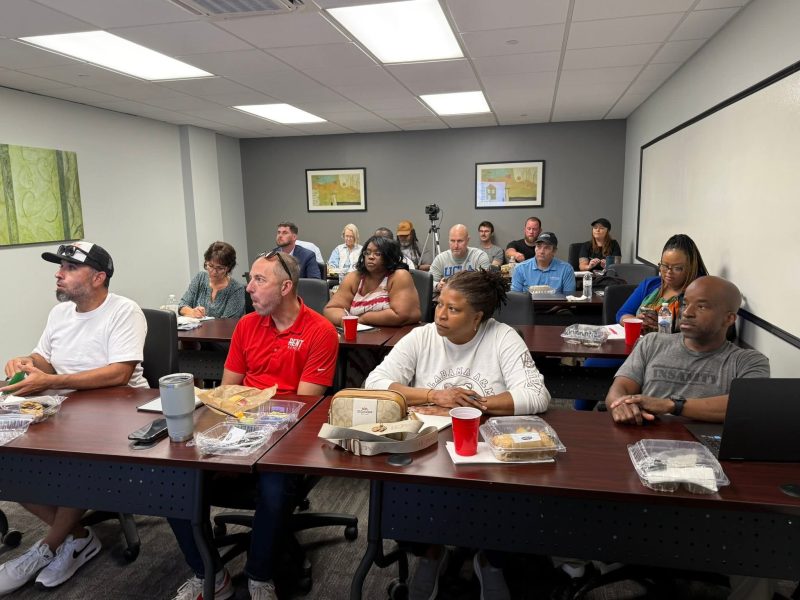
Last month, families, instructors, and graduates gathered at Main Street Wedding and Event Venue to celebrate JumpStart EVV’s inaugural cohort. The crowd was so large that it was standing room only, and the graduates beamed as their names were called.
“It was a big deal,” said Taylor Price, executive director of CDFI Friendly Evansville Region. “I’d ask them, ‘Are you proud of yourself?’ and they’d say yes. And I’d tell them, ‘I’m so proud of you.”
Nineteen residents completed the 10-week developer training program—launched to help everyday Evansville residents acquire the skills, mentorship and financing knowledge needed to become small-scale developers. They’re graduating into a market where those skills are needed.
Home prices in the region have climbed 43 percent since 2019. Median rent has risen about 23 percent. Twenty-one percent of renters are severely cost-burdened, spending at least half their income on housing. And Indiana has only 38 affordable and available homes for every 100 extremely low-income renters.
Add in aging housing stock—much of it in need of major rehab or full redevelopment—and the city faces a problem too complex for large developers alone.
JumpStart EVV aims to train residents to fill that gap.
A 10-Week Program Designed for Real Projects
JumpStart EVV, modeled after national programs in cities like Philadelphia and Indianapolis, met weekly for two hours and brought in local lenders, contractors, appraisers and developers as instructors. The City of Evansville funded the cohort, allowing for catered meals, instructional materials and a full graduation ceremony.
“Bringing in subject-matter experts was key,” Price said. “We wanted people to walk away with skills they could use immediately.”
Participants learned how to:
- Evaluate rehab and infill construction costs
- Understand zoning and permitting
- Build development budgets and pro formas
- Navigate loan products, grants and tax tools
- Strengthen personal and business credit
Each participant had to arrive with a project concept in mind—whether a vacant lot, a longtime dream property, or a blighted house they pass every day on the way to work.
“That keeps the learning grounded,” Price said. “Otherwise, it becomes overwhelming.”
The program now extends beyond the classroom: nearly every graduate has been paired with a mentor for 12 months, and Price secured a $50,000 CenterPoint Energy grant that will fund micro-grants for pre-development costs such as surveys, architectural drawings, or rezoning fees.
“That first thousand dollars is often where people get stuck,” she said. “We want to remove that barrier.”
Graduate Spotlight: What JumpStart Meant for Tiko Blane
Evansville investor and entrepreneur Tiko Blane entered JumpStart EVV with years of rehab experience, but he joined for a reason shared by many participants: he wanted to build.
“I knew rehabs,” Blane said. “But I didn’t know what it looked like to structure a new build as an investor.”
JumpStart helped him understand development financing tools he didn’t previously know existed—grants, forgivable loans, tax-increment financing options, and how to “stack” funding sources.
“That was the biggest surprise,” he said. “I had no idea there were programs that could help make these projects feasible.”
Blane plans to explore building a two- to four-unit multifamily property on one of several lots he is evaluating, a scale of project more aligned with the neighborhoods experiencing the most need.
“There’s definitely demand for more units in Evansville,” he said. “I want to be part of filling that gap.”
He also sees long-term value in the network JumpStart built around him—developers, the Indiana Small Business Development Center, and his formal mentor, Phillip Hooper.
“You need people who get what you’re trying to do,” Blane said. “This program gave us that.”
Housing Needs That Go Beyond New Construction
Price says Evansville’s housing challenges are layered: aging houses, inefficient utilities, disinvestment in historic neighborhoods and rising costs that make even modest homes hard to maintain.
“A lot of our stock is dilapidated,” she said. “Some homes can be saved, others can’t. But you need people with the skills to tell the difference—and to do the work.”
Energy efficiency is one part of the affordability picture. Older homes often leak air, have worn-out windows, or lack insulation, making utility bills, already high in this region, crushing for families on tight budgets.
“Affordability isn’t just the mortgage,” Price said. “It’s being able to keep the lights on.”
Meanwhile, Indiana Landmarks has expressed interest in supporting JumpStart participants interested in preservation work—projects that are expensive but essential to protecting the city’s architectural character.
Why CDFI Friendly Matters—Especially Now
JumpStart EVV is run through CDFI Friendly Evansville Region, which connects residents and businesses to mission-driven lenders known as CDFIs (Community Development Financial Institutions). These lenders can fund housing, small businesses, and community development projects that traditional lenders might decline.
In its first two years, CDFI Friendly has supported first-time homebuyers, a solar equipment refinance, local entrepreneurs, and has participated directly in several loans to make them more attractive to CDFIs.
But the national landscape is shifting. The federal CDFI Fund, which supports many CDFIs nationwide, has faced repeated attempts by the Trump administration to cut its funding, restrict equity-focused projects, and even eliminate staff. In a bipartisan twist, Senate Republicans have defended the program, proposing level funding, but much of the money approved by Congress remains frozen and could expire in 2026 if not released.
For Price, this uncertainty highlights the value of local institutions. “When federal support is unstable, communities depend on connectors like us even more,” she said.
CDFI Friendly recently deepened its partnership with Kansas City–based lender AltCap, which will begin sending a national New Markets Tax Credit expert to Evansville each month—opening new financing possibilities for small developers.
Price also envisions eventually becoming a certified CDFI able to offer small consumer loans that help residents avoid predatory lending.
“That’s where I see us going,” she said. “And JumpStart will remain part of that pipeline.”
What’s Next
Applications for the next JumpStart EVV cohort open mid-January, with classes beginning in March. Interest is already strong. “We’ll have to vet applicants carefully,” Price said. “We want people who are serious and intentional.”
During graduation, two young developers from South Bend spoke to the class about how completing a similar JumpStart program led them to acquire more than 30 properties.
“They asked the group: ‘Which one of you will be the next success story?’” Price said. “Looking at this class, I think we’ll have several.”
Author

Related Articles

Rotary Club honors Sondra Matthews with Civic Award
Sondra Matthews has spent decades telling Evansville’s stories, preserving Black history, mentoring leaders, and building institutions that continue to shape the community. Now, the Rotary Club of Evansville has honored her with its 2026 Civic Award—recognizing a legacy rooted in faith, service, and generations of impact.

More Than Remembrance: Evansville Honors the Life and Legacy of Dr. King
The community honored the life and legacy of Dr. King through various celebrations across the city of Evansville.
Indiana Senate Rejects Redistricting Plan After Intense Debate
Indiana Senate rejects redistricting plan.